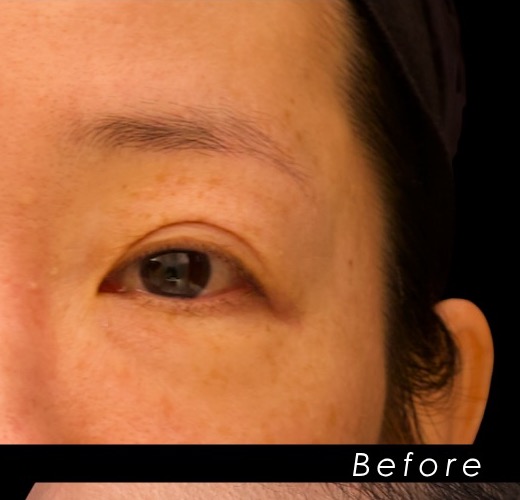
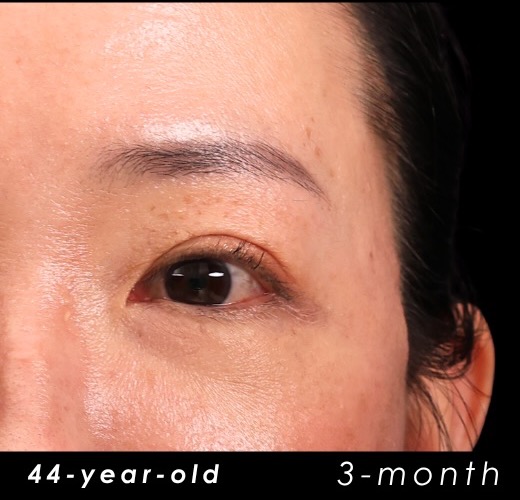
This patient underwent a short-incision temporal lift for laxity around the outer corner of the eye. Through small incisions hidden within the hair, the SMAS and muscles of facial expression were repositioned to restore appropriate tension in the temporal region. Photographs at three months show the change through the concept of SMAS RESET.
Case summary
- Age: 44 years
- Primary concern: laxity around the outer corner of the eye
- Procedure: short-incision temporal lift
- Treatment course: one operation followed by several postoperative examinations and follow-up visits
- Photographic time points: before surgery / three months after surgery
Priorities in this case
A temporal lift may be performed through a hairline incision or through small incisions within the hair-bearing scalp. In this case, a short-incision temporal lift was selected to keep the scars less visible from the outside while naturally addressing laxity around the outer corner of the eye.
The concept of SMAS RESET was applied to the lateral upper face. Lax SMAS and muscles of facial expression were repositioned with appropriate tension so that continuity from the temple to the outer corner of the eye could be restored, rather than pulling strongly on the skin surface at the outer eye alone.
Under SMAS RESET, as the outer corner of the eye is elevated, the SMAS of the central face and central forehead is also shifted upward. This allows the outer corner of the eye to rise without creating an excessively upturned appearance, maintaining balance across the forehead and eye area.
Planning the operation in this way helps avoid unnecessary over-elevation of the outer corner of the eye. It is important to assess its relationship with the entire upper face, preserve the patient’s characteristic facial features and avoid an over-pulled appearance.
Procedure selected and its purpose
Short-incision temporal lift
Small incisions are made within the temporal hair-bearing scalp on both sides, and the tissues extending from the outer corner of the eye to the temporal region are elevated through these incisions. Because the incision lines are hidden within the hair, the scars are less visible from the outside.
The incision location and indications differ from those of a hairline-incision temporal lift. The procedure is selected after assessing the degree of laxity around the outer corner of the eye, balance with the forehead and midface, and the patient’s desired change.
Changes visible at three months
At three months, laxity around the outer corner of the eye is improved and the contour of the upper face appears naturally more defined. An important point under the concept of SMAS RESET is that the change follows a continuous line from the temple to the outer corner of the eye rather than appearing as isolated over-elevation of the outer eye. Placing the incisions within the hair also keeps them less visible from the front.
Three months is one of the time points at which swelling has subsided and the change can be assessed more readily. Scar maturation and sensation may continue to change thereafter. Results and recovery vary between patients, and the same degree of change cannot be guaranteed.
Treatment course and fees
- Usual treatment period and number of visits: One operation, followed by several postoperative examinations and follow-up visits. The exact number varies between patients and may also differ according to the conditions of the monitor discount.
- Total fee for the procedures shown (tax included): ¥693,000 (including anesthesia; partial-face monitor discount applied)
- Breakdown: Short-incision temporal lift (partial-face monitor) ¥528,000 + general anesthesia with mechanical ventilation ¥165,000
*The fees shown above apply at Cinderella & Da Vinci Clinic. International patients are accepted through Your Face Clinic. Please refer to the price list for international patients (PDF) for the applicable fees.
Principal risks, adverse effects and complications
Possible risks include bleeding, hematoma, infection, swelling, bruising, pain, visible scarring, delayed wound healing, hair loss around the incision, altered sensation, nerve injury including facial nerve dysfunction, asymmetry, overcorrection or undercorrection, recurrence and a result that differs from the patient’s expectations.
Author and medical review
- Written and medically reviewed by: Shoichi Sasaki, M.D.
- Created: July 26, 2026
For detailed information about treatment, fees, principal risks and potential adverse effects, please refer to the explanation provided during your consultation.